



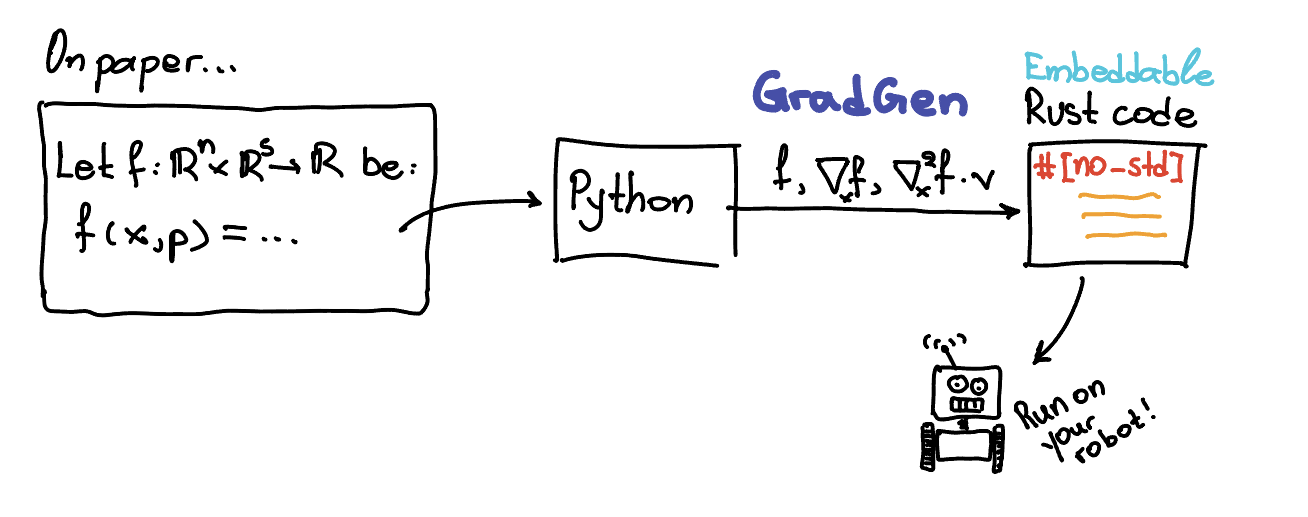
Gradgen is a Python library for symbolic differentiation and (embedded) Rust code generation.
Here is an example where we will define the function
for a three-dimensional input
The goal is to generate Rust code for the functions
Furthermore, we want to generate a Rust function that computes simultaneous FunctionBundle below).
from gradgen import CodeGenerationBuilder, Function, RustBackendConfig, SXVector, sin

# Define the symbolic inputs.
x = SXVector.sym("x", 3)
u = SXVector.sym("u", 1)

# Build a simple scalar-valued function of x and u
# f(x, u) = ||x||_2^2 + u_1 * sin(x_1) + x_2 * x_3
f_expr = x.norm2sq() + u[0] * sin(x[0]) + x[1] * x[2]

# Define a Function object
f = Function(
    "energy",
    [x, u],
    [f_expr],
    input_names=["x", "u"],
    output_names=["energy"],
)

# (Optional) Evaluate f in Python
x_value = [1.0, 2.0, -0.5]
u_value = [3.0]
print("f(x, u) =", f(x_value, u_value))

# Generate code
project = (
    CodeGenerationBuilder()
    .with_backend_config(
        RustBackendConfig()
        .with_crate_name("my_kernel")
        .with_backend_mode("no_std")
        .with_scalar_type("f64")
    )
    .for_function(f)
        .add_primal()
        .add_jacobian()
        .add_joint(
            FunctionBundle()
            .add_f()
            .add_jf(wrt=0)
        )
        .with_simplification("medium")
        .done()
    .build(Path(__file__).resolve().parent / "codegen_kernel")
)
See the demos and this more complete tutorial.
In applications such as optimal control, the generated code can become too large very easily. However, the problem structure can be exploited to generate code with complexity that doesn't increase with the prediction horizon.
Instead of completely unrolled code, Gradgen exploits the problem structure to create high-performance, human-readable embeddable Rust code.
See this complete tutorial for details.
- Truly embdedable safe Rust code with optional
#[no_std], no dynamic memory allocation, nopanic!s - Specialised code generation tools for optimal control problems (docs)
- Very efficient code generation thanks to modular code generation using
map,zip,repeat, andchainhigh-order functions. - Supports both single (
f32) and double (f64) precision arithmetic
See the demos and this more complete documentation for details.
If you find Gradgen useful, give us a star on GitHub!